Genetic Morphs
Dunner
Bearded Dragon
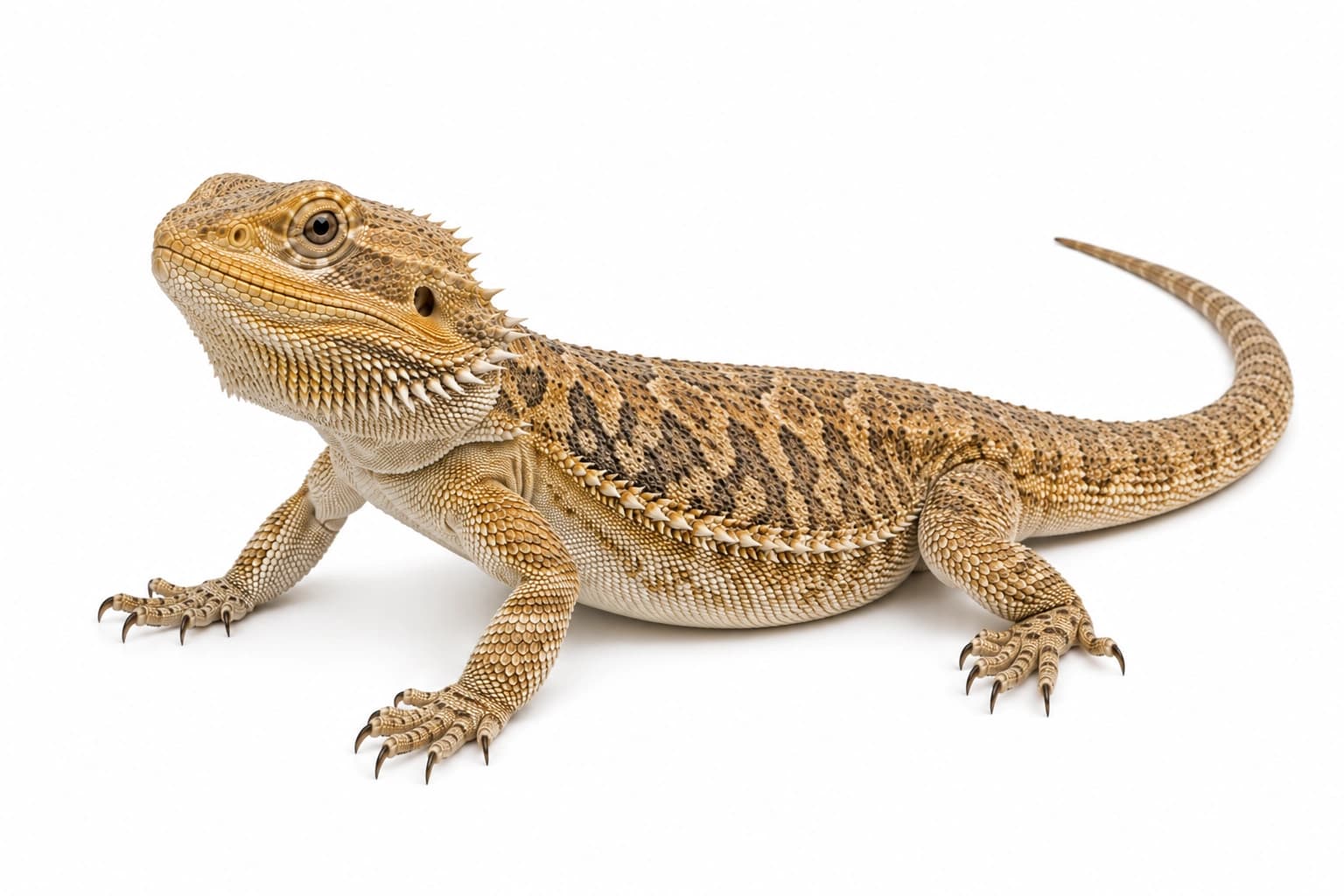
A distinctive genetic morph recognised by scales that point in multiple directions, irregular beard spikes and a disrupted body pattern.
The Dunner Bearded Dragon is a visually distinctive genetic morph of Pogona vitticeps. It primarily affects the direction, shape and organisation of the scales, producing a rougher and more chaotic appearance than that of a Normal Bearded Dragon.
Trait type
Scale and pattern morph
Inheritance
Dominant
Primary feature
Multidirectional scales
Pattern
Irregular and disrupted
Beard spikes
Often point outward
Colour effect
None directly
Morph DNA
Dunner Morph Profile
trait
Dunner
trait Type
A genetic structural trait affecting scale orientation, scale shape and pattern organisation
inheritance
A visual Dunner normally inherits the Dunner trait from at least one visual parent
visual Expression
Scales pointing in several directions, irregular scale rows, disrupted markings and unusual beard-spike orientation
hidden Traits
Dunner is visually expressed and is not normally described using recessive carrier terminology such as het Dunner
beginner Friendly
Yes. A healthy Dunner generally requires the same husbandry as any other healthy Bearded Dragon.
Morph Overview
What Is a Dunner Bearded Dragon?
The Dunner Bearded Dragon is one of the most recognisable structural morphs of Pogona vitticeps.
Unlike colour traits such as Red, Orange, Yellow or Citrus, Dunner does not create one specific body colour. Its main effect is on the physical organisation and direction of the scales.
In a Normal Bearded Dragon, most scales are arranged in relatively orderly rows and generally point towards the rear of the body. In a Dunner, many scales point sideways, forwards, diagonally or in apparently random directions.
This unusual scale orientation gives the dragon a rough, highly textured and sometimes heavily armoured appearance.
The individual scales may also appear more raised, rounded or conical than those of a Normal Bearded Dragon. This is especially noticeable across the back, sides, limbs and beard.
Dunner also affects the organisation of the body pattern.
Normal Bearded Dragons commonly display horizontal bands, symmetrical markings and relatively predictable pattern alignment. In a Dunner, these markings may appear broken, scattered, vertical, diagonal or asymmetrical.
The pattern on one side of the body may differ noticeably from the pattern on the other side.
The tail is another useful identification area. Instead of forming clean horizontal rings, the markings may appear as broken bands, short dashes, vertical bars or irregular fragments.
The beard often shows one of the clearest Dunner characteristics. Beard spikes may point sideways, outward, forwards or in several directions rather than forming a neat downward-facing arrangement.
Some Dunner dragons also display unusually scattered markings on the underside. Instead of organised oval belly markings, the pattern may appear as small spots, short lines or irregular shapes.
However, belly markings alone cannot confirm the morph.
Dunner should not be confused with Leatherback.
Leatherback primarily reduces the size and prominence of the dorsal scales, creating a smoother back. Dunner primarily alters scale direction and organisation, often producing a rougher and more disordered appearance.
The two traits can occur together in the same animal.
A Dunner Leatherback may display the smaller dorsal scales associated with Leatherback while still showing multidirectional scale orientation, irregular beard spikes and disrupted patterning.
Dunner can also be combined with Hypo, Translucent, Genetic Stripe, Zero, Witblits and selectively bred colour lines.
Because Dunner does not directly determine colour, a Dunner Bearded Dragon may be brown, tan, yellow, orange, red, grey or nearly any other colour produced through separate genetics and selective breeding.
Head Details
Head, Beard and Facial Scale Direction
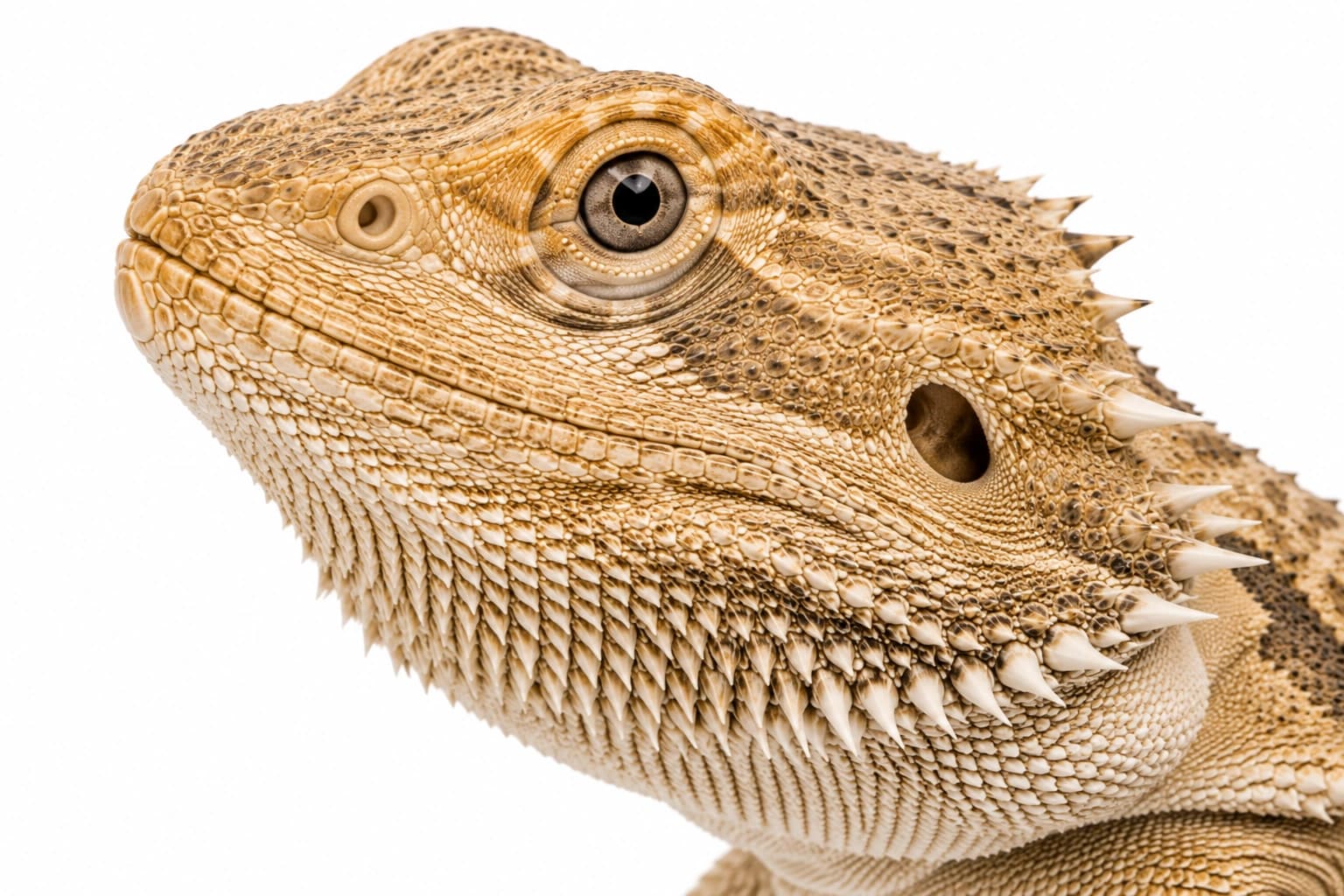
The head of a Dunner Bearded Dragon retains the broad triangular shape typical of Pogona vitticeps, but the arrangement of the facial scales may appear noticeably irregular.
Scales around the brow, cheeks, jaw and sides of the head may point in several different directions instead of forming consistent rows.
The beard is one of the most useful areas for identifying the Dunner morph.
In a Normal Bearded Dragon, the beard spikes generally follow a relatively organised downward or backward direction.
In a Dunner, individual beard spikes may project sideways, outward, forwards or diagonally. This can make the beard look wider, rougher or less symmetrical.
The spikes on one side of the beard may point differently from those on the opposite side.
Facial markings may also appear irregular. Lines and patches around the eyes, jaw and sides of the head can be fragmented or asymmetrical.
However, pattern disruption alone is not enough to confirm Dunner. The physical direction of the scales should always be examined.
Dunner does not directly alter the internal pigmentation of the eyes.
Solid dark eyes are more closely associated with the Translucent morph, although eye appearance can vary.
The Dunner mutation also does not create clear claws. Clear or reduced-pigment claws are associated with Hypo.
Head colour depends on the dragon's wider genetics and selective colour lineage.
Characteristic Feature
Multidirectional Scale Orientation
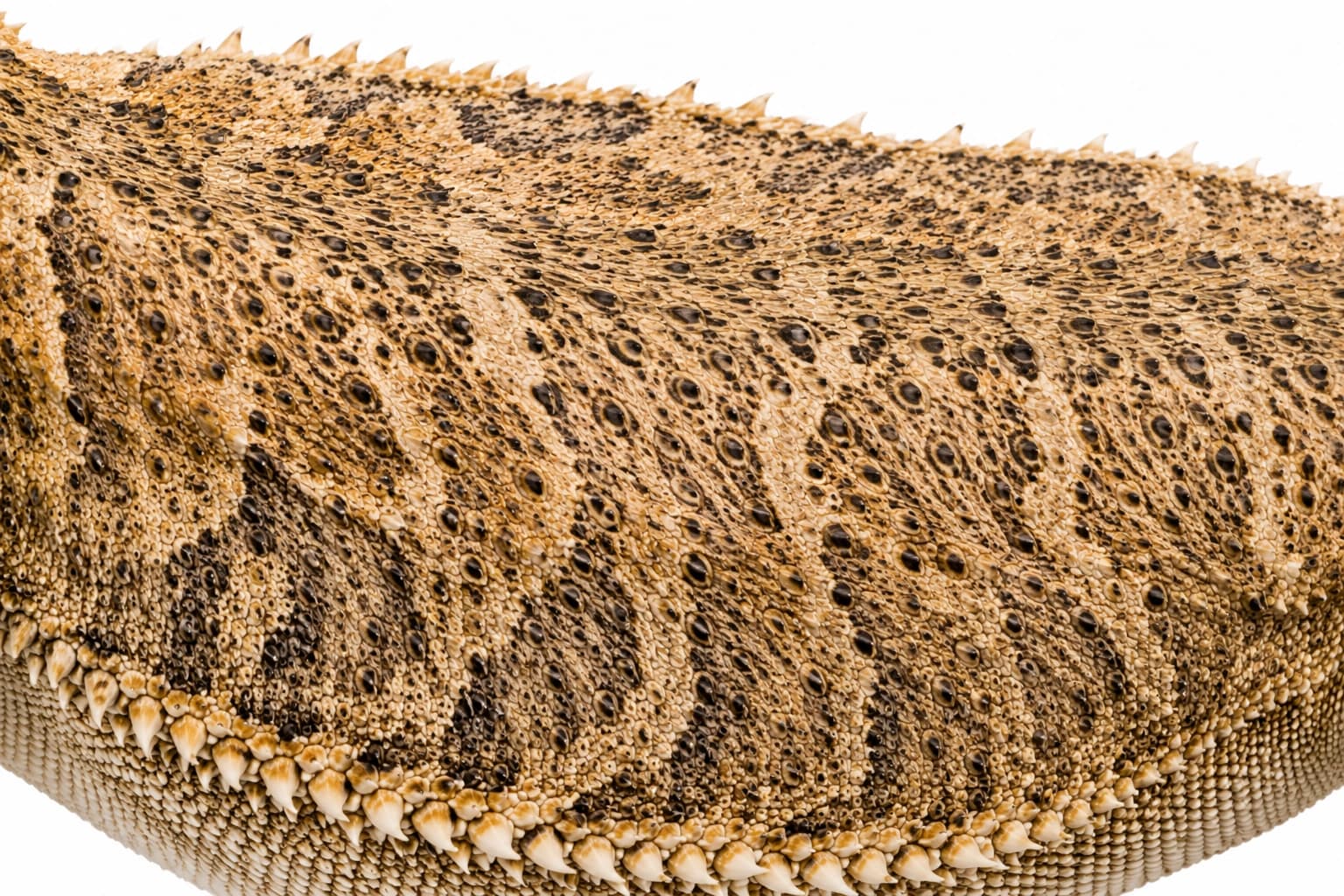
The defining characteristic of the Dunner morph is multidirectional scale orientation.
On a Normal Bearded Dragon, scales typically follow organised rows and point predominantly towards the rear of the body.
On a Dunner, scales may point forwards, sideways, diagonally, upwards or backwards within the same small region.
This creates a visibly irregular surface.
Many Dunner scales also appear more raised, rounded or conical than the flatter and more uniformly aligned scales of a Normal Bearded Dragon.
The unusual scale direction can be present across the back, sides, shoulders, legs, tail, beard and underside.
The feature should be visible repeatedly across several areas of the body.
One or two incorrectly positioned scales do not prove that a dragon is Dunner.
Normal Bearded Dragons can occasionally have isolated scale abnormalities caused by natural variation, injury, scarring, retained shed or developmental irregularities.
A true Dunner generally displays consistent multidirectional scale organisation across multiple body regions, together with other supporting features such as irregular beard spikes and disrupted patterning.
The characteristic should also be distinguished from Leatherback.
Leatherback reduces the size and prominence of the dorsal scales, producing a smoother and less heavily spiked back.
Dunner changes the direction and arrangement of the scales and often creates a rougher, more chaotic appearance.
When Dunner and Leatherback occur together, the scales may be smaller but still point in irregular directions.
Identification Guide
How to Identify a Dunner Bearded Dragon
To identify a Dunner Bearded Dragon, begin by examining the physical direction of the scales.
Do not begin with colour.
Dunner does not create a specific colour, and the morph can occur in brown, tan, red, orange, yellow, grey and other selectively bred colour lines.
Inspect the back and sides under clear lighting.
A visual Dunner should show repeated areas where scales point forwards, sideways or diagonally rather than following consistent rear-facing rows.
Look closely at the shape of the scales.
Many Dunner scales appear raised, rounded or conical. The body surface may look uneven and heavily textured.
Next, examine the beard.
Dunner beard spikes frequently point outward, sideways or in mixed directions. The beard may appear less organised than that of a Normal Bearded Dragon.
Inspect the body pattern.
Dunner markings are often asymmetrical, fragmented, scattered or angled. Bands may fail to align evenly across the body.
Examine the tail.
Instead of clean horizontal rings, a Dunner may display broken bands, short dashes, vertical fragments or irregular markings.
The belly may provide additional supporting evidence.
Some Dunners show scattered spots, short marks or disrupted belly patterns rather than organised oval markings.
However, belly spotting is variable and should not be used as the only identification feature.
Do not identify Dunner from pattern alone.
Selective breeding, natural variation and stress markings can produce irregular patterns without altering the direction of the scales.
Do not identify Dunner from rough texture alone.
A standard-scaled Normal Bearded Dragon is naturally rough, and retained shed or skin damage can temporarily change the surface texture.
The strongest visual identification is based on a combination of:
multidirectional scales,
raised or conical scale shape,
irregular beard spikes,
disrupted body and tail pattern,
and documented lineage.
Dunner is a visually expressed dominant trait.
The term “het Dunner” is generally not used in the same way as “het Hypo” or “het Translucent”, because those terms describe hidden carriers of recessive traits.
A dragon carrying and expressing the Dunner allele is expected to show visible characteristics of the morph.
Juvenile Development
Juvenile Dunner Bearded Dragons
Young Dunner Bearded Dragons often display the characteristic scale orientation from an early age, although the expression may be less pronounced than in mature adults.
Hatchlings and juveniles usually possess the same dominant genetic trait responsible for multidirectional scales, but the smaller body size can make the feature more subtle.
As the dragon grows, the irregular scale arrangement generally becomes easier to recognise across the back, shoulders, beard and tail.
The juvenile pattern is often more contrasting than in adults. Dark bands and markings may appear bold, but unlike a Normal Bearded Dragon, these markings frequently look fragmented or asymmetrical.
The beard spikes can already show abnormal orientation, although they usually become more obvious after several sheds.
Juvenile Dunners often develop their characteristic appearance gradually during the first year of life.
Because Dunner does not influence colour genetics, juveniles may hatch in almost any colour depending on their bloodline.
Red Dunners, Citrus Dunners, Zero Dunners and Hypo Dunners all begin life with the same underlying scale mutation while expressing their own independent colour genetics.
Healthy juvenile Dunners should grow, shed and feed in exactly the same way as any other healthy Bearded Dragon.
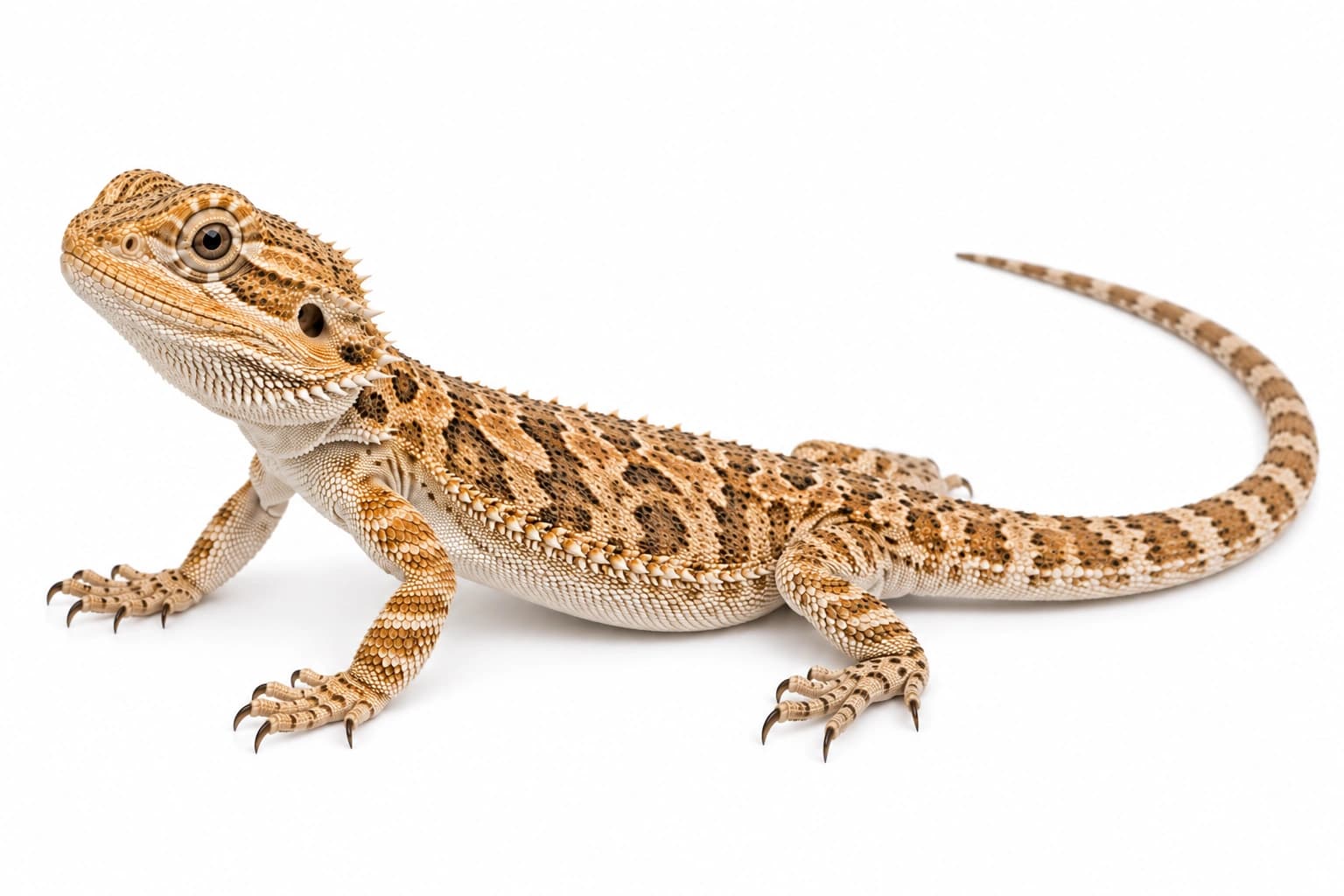
Appearance
Dunner Bearded Dragon Appearance
The appearance of a Dunner Bearded Dragon is defined primarily by texture, scale direction and pattern disruption.
The most important feature is the orientation of the scales.
Rather than following consistent rows, many Dunner scales point in several different directions within the same area of the body. Some may point towards the head, while neighbouring scales point sideways or towards the tail.
This gives the skin a disorganised and uneven appearance.
The scales may also be more prominent, raised or conical. When viewed from the side or under angled light, the surface can look noticeably rougher than that of a Normal Bearded Dragon.
The degree of expression varies between individuals.
Some Dunners display extremely obvious multidirectional scales across the entire body. Others show more moderate expression that is most visible around the shoulders, sides, limbs, beard or tail.
The body pattern is commonly irregular and asymmetrical.
Markings that would usually form horizontal bands may become broken, stretched or angled. Spots may appear in unusual positions, and the pattern may not match evenly across both sides of the body.
Some Dunner dragons display short vertical marks along the sides or tail. These can replace the more conventional horizontal pattern seen in many Normal dragons.
The dorsal pattern may appear scattered or fragmented rather than forming organised shapes.
The limbs can also show unusual scale direction and irregular markings. Scales on the legs and toes may not follow the same orderly arrangement seen in a Normal Bearded Dragon.
The beard frequently appears wider, rougher or more disorganised because individual spikes point outward or sideways.
The tail pattern can be especially useful when identifying Dunner. Normal tail bands often wrap around the tail in relatively complete rings. Dunner markings may form incomplete bands, small dashes or irregular vertical fragments.
The underside may contain scattered spots or broken markings. These should be treated as supporting evidence rather than a definitive diagnostic feature.
Dunner does not create a particular eye colour.
A Dunner with solid dark eyes may also carry or visually express Translucent. A Dunner with clear claws may also be Hypo.
Similarly, bright red, yellow or orange pigmentation comes from separate colour-line breeding and is not caused by the Dunner mutation itself.
Adult Development
Adult Dunner Bearded Dragon
Adult Dunner Bearded Dragons display the mutation much more clearly than juveniles.
With maturity, multidirectional scales become increasingly obvious across the body. The raised texture gives many adults a noticeably rougher appearance than Normal dragons.
The beard often becomes one of the strongest identification points.
Large beard spikes may project sideways, forwards or in multiple directions, producing a fuller and less organised appearance.
Pattern disruption also becomes more pronounced with age.
Instead of clean horizontal bands, adults frequently display broken markings, irregular blotches, scattered spots and disrupted tail rings.
Expression varies considerably between individuals.
Some adults exhibit dramatic multidirectional scaling across almost every part of the body, while others show a more moderate expression limited to certain regions.
Despite these differences, the defining feature remains the same: repeated irregular scale orientation rather than colour.
An adult Dunner should still retain the normal body proportions, activity level and behaviour expected of a healthy Bearded Dragon.
Genetics
Dunner Genetics and Inheritance
The Dunner morph follows a dominant mode of inheritance.
Unlike recessive traits such as Hypo or Translucent, only one copy of the Dunner allele is generally required for the trait to be visually expressed.
This means that visual Dunners typically inherit the mutation from one visual parent.
Because Dunner is a dominant trait, breeders generally do not use terms such as "het Dunner" in the same way they do for recessive morphs.
A dragon carrying the Dunner mutation is expected to show visible characteristics of the morph.
The intensity of expression may vary.
Some individuals display dramatic multidirectional scaling across the entire body, while others show a milder phenotype with fewer obvious features.
Dunner can be combined with many other morphs, including:
• Hypo
• Translucent
• Leatherback
• Genetic Stripe
• Zero
• Witblits
• Citrus
• Red Monster
Each additional morph contributes its own independent characteristics without altering the dominant inheritance of Dunner itself.
Inheritance
Dominant
Visual expression
One copy is generally sufficient
Hidden carrier
Not normally applicable
Can combine with other morphs
Yes
Primary effect
Scale orientation and pattern organisation
Colour gene
No
Care Guide
Caring for a Dunner Bearded Dragon
A healthy Dunner Bearded Dragon generally requires the same husbandry as any other healthy Pogona vitticeps.
The Dunner mutation changes scale orientation and pattern organisation, but it does not normally require a different enclosure, diet, UVB system or temperature range.
A suitable enclosure should provide enough space for natural movement, climbing, basking, hiding and thermoregulation.
The basking area must allow the dragon to reach an appropriate body temperature, while the opposite side of the enclosure should remain cooler so that the animal can regulate its temperature naturally.
High-quality linear UVB lighting is essential.
UVB supports vitamin D3 synthesis, calcium metabolism, skeletal development and overall health. The UVB tube should overlap with the basking zone so that the dragon receives heat and ultraviolet exposure at the same time.
The exact basking surface temperature should be adjusted according to the dragon's age, behaviour, body condition and enclosure design.
Surface temperatures should be measured with a reliable infrared thermometer, while ambient temperatures can be monitored with digital probe thermometers.
Dunner dragons do not require additional humidity because of their unusual scales.
Like other central Bearded Dragons, they should normally be maintained in a relatively dry enclosure with access to appropriate hydration through fresh greens, correctly gut-loaded feeders and clean water where suitable.
Diet should be based on age.
Juveniles require more frequent access to appropriately sized live insects to support rapid growth. Adults should receive a greater proportion of leafy greens and suitable vegetables, with insects offered in controlled quantities.
All feeder insects should be appropriately sized, gut-loaded and supplemented according to a balanced calcium and vitamin schedule.
Because Dunner scales point in several directions, retained shed may occasionally be more difficult to notice in small areas around the beard, limbs, toes and tail.
However, there is no evidence that every Dunner automatically experiences abnormal shedding.
The dragon should be inspected regularly, especially during a shed cycle.
Retained shed should never be forcibly pulled from the skin. Appropriate hydration, correct enclosure temperatures and access to textured surfaces usually allow healthy dragons to shed naturally.
Some breeders and keepers describe Dunner dragons as messy eaters or report that they occasionally hold food in the mouth longer than expected.
These observations are not universal and should not be treated as defining characteristics of the morph.
Any persistent difficulty swallowing, repeated food retention, weight loss, mouth swelling or abnormal behaviour should be assessed by a qualified reptile veterinarian.
Routine care should include regular weight monitoring, nail checks, observation of faecal quality and veterinary testing when parasites or illness are suspected.
The Dunner morph itself should never be used as an explanation for symptoms that may indicate a genuine medical problem.
Breeding
Dunner Breeding and Genetic Outcomes
Because Dunner is a dominant trait, breeding outcomes are generally straightforward.
Pairing a visual Dunner with a Normal Bearded Dragon commonly produces approximately fifty percent Dunner offspring and fifty percent Normal offspring, assuming only one parent carries the mutation.
Breeding two visual Dunners together increases the proportion of Dunner offspring but may also produce individuals carrying two copies of the dominant allele.
Although no widely accepted evidence suggests that homozygous Dunners experience the same concerns associated with some historical Translucent bloodlines, many breeders still prioritise maintaining genetic diversity through careful outcrossing.
When selecting breeding animals, overall health, temperament, body condition and unrelated bloodlines remain far more important than the Dunner trait itself.
The mutation can be safely combined with many other established morphs to create visually unique offspring.
Dunner × Normal
Approximately 50% Dunner and 50% Normal offspring when the Dunner parent carries a single copy of the trait.
Dunner × Dunner
Produces predominantly Dunner offspring. Expression may vary between individuals depending on their genetics.
Dunner × Leatherback
May produce offspring displaying both reduced dorsal scales and multidirectional scale orientation if the Leatherback trait is inherited.
Hypo Dunner × Hypo
Can produce Hypo Dunner offspring while maintaining the dominant Dunner phenotype in individuals inheriting the Dunner allele.
Dunner × Translucent
Can produce Dunner offspring carrying or expressing the Translucent trait depending on the genetics of both parents.
Morph Comparison
How Dunner Compares With Other Morphs
Frequently Asked Questions
Dunner Bearded Dragon FAQ
What is a Dunner Bearded Dragon?
A Dunner Bearded Dragon is a genetic structural morph with scales that point in multiple directions. The trait commonly produces raised or conical scales, irregular beard spikes and disrupted body and tail patterns.
How can you identify a Dunner Bearded Dragon?
Examine the physical direction of the scales across the back, sides, beard and tail. A true Dunner should display repeated multidirectional scale orientation across several body regions, often together with irregular beard spikes and broken patterning.
Is Dunner a colour morph?
No. Dunner primarily affects scale direction, scale structure and pattern organisation. A Dunner can occur in many colours, including brown, yellow, orange, red and grey.
Is the Dunner morph dominant or recessive?
Dunner is generally described as a dominant trait. A dragon inheriting the Dunner allele is expected to visually express the morph, although the strength of expression can vary.
Can a Bearded Dragon be het Dunner?
The term het Dunner is generally not used because Dunner is visually expressed as a dominant trait. Het terminology is mainly used for hidden carriers of recessive mutations such as Hypo or Translucent.
Is Dunner the same as Leatherback?
No. Leatherback reduces the size and prominence of the dorsal scales, creating a smoother back. Dunner changes the direction and organisation of the scales and often creates a rougher, more chaotic texture.
Can a Bearded Dragon be both Dunner and Leatherback?
Yes. A Dunner Leatherback can inherit both traits, displaying reduced dorsal scalation together with multidirectional scales, irregular beard spikes and disrupted patterning.
Do all Dunner Bearded Dragons have spotted bellies?
No. Some Dunners display scattered belly spots or irregular underside markings, but this feature varies and cannot confirm the morph on its own.
Do Dunner Bearded Dragons have different eyes?
Dunner alone does not alter eye pigmentation. Solid dark eyes are more closely associated with Translucent, while normal eye variation can occur in any morph.
Do Dunner Bearded Dragons have clear claws?
Not because of the Dunner trait. Clear or reduced-pigment claws are associated with Hypo. A dragon can be both Hypo and Dunner.
Do Dunner Bearded Dragons require special care?
A healthy Dunner generally requires the same husbandry as any other healthy Bearded Dragon, including correct UVB, heating, diet, supplementation and enclosure space.
Do Dunner Bearded Dragons have shedding problems?
Not every Dunner has shedding problems. Their irregular scales can make retained shed less obvious in some areas, so regular inspection is useful, but normal husbandry should allow healthy shedding.
Are Dunner Bearded Dragons healthy?
The Dunner trait itself is not normally considered a reason for poor health. Health depends more strongly on breeding quality, genetic diversity, nutrition, UVB exposure, temperatures and veterinary care.
Can Dunner be combined with Hypo or Translucent?
Yes. Dunner can be combined with independently inherited traits such as Hypo, Translucent, Leatherback, Zero, Witblits and Genetic Stripe.
Does Dunner pattern become easier to see with age?
The multidirectional scales are genetically present from a young age, but larger adult scales and beard spikes often make the phenotype easier to recognise as the dragon matures.
Are irregular markings enough to prove a dragon is Dunner?
No. Pattern alone is not sufficient. Identification should be based primarily on repeated multidirectional scale orientation, supported by beard, body and tail characteristics and documented lineage.
Continue Exploring
Related Morphs
Continue Learning
Bearded Dragon Care Guides
Explore our practical guides covering enclosure setup, UVB lighting, heating, feeding, humidity, enrichment and everyday Bearded Dragon care.
Explore Care Guides →Scientific References
This article was prepared using established zoological, husbandry and scientific references.